High Plains Gardening
The gardening website of the Texas High Plains Region




Leaf color is primarily a light grayish green, not solid green or gray.
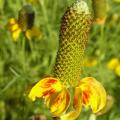
You can't have just one. As soon as you plant one, you'll have a drift, then a sweep, then a field if you have the space. But I still don't consider the prairie coneflower to be invasive, merely pleasant. Next to the Indian Blanket, the Mexican Hat shouts Southwest prairies. And its a tough hombre. If your stand becomes too dense or too much, just weed some out. They're adaptable to most native soils and will thrive on available or once a month supplementation. Coneflowers bloom yellow, reddish or brown late spring into fall and make an attractive display when mixed.
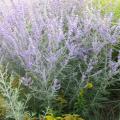
Russian sage is a must have shrub for every low water-use landscape. Russian sage is used extensively throughout our southwest landscapes, planted along with Buddleia, Carl Forester Reed Grass, Salvia greggii cultivars, Anisacanthus quadrifidis wrightii and Hesperaloe parviflora. It is hard to beat its use where a long flowering, showy, low care, drought tolerant shrub is needed.
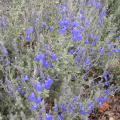
Mexican blue sage is a native of Mexico and in many references labels it cold hardy to USDA Zone 8, however, it has wintered over in Amarillo many years now, even in full northern exposure. It has died back to the ground once or twice, but comes back up from the roots. If good to well drained soil is provided, it should do fine. And I hope you can provide that, as Mexican blue sage is one of my top plants to include in xeric gardens. True bright blue flowers bloom summer and fall with once a month watering. Butterflies are attracted to it. Indispensable.
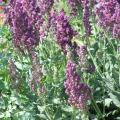
Unlike, S. nemorosa ‘May Night’, I don’t mind deadheading this salvia, perhaps because of its plum color it does not require as persistent deadheading. Notice the gray-green leaves of ‘Plumosa’, versus the green leaves of ‘May Night’. The stems tend to flop, but the flower stalks continue to grow and flower upright -- very strange.
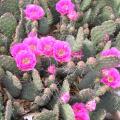
Not all succulents are cacti, nearly all cacti are succulents (a few exceptions). Nearly all cactus species are native to the Americas, providing a prickly evergreen presence. There are many cactus that are cold hardy for the Texas Panhandle. There might be one for your garden.
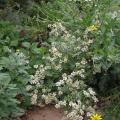
A non-invasive tansy from southern and central Europe for your low water-use bed and border that will reseed somewhat. A short lived perennial. Gray cut-leaf foliage provides an attractive white element in the garden.
Strongly aromatic.
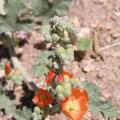
Gooseberryleaf globemallow is very close in appearance to scarlet globemallow, Sphaeralcea coccinea, but much taller, up over 2 feet. The leaves are silver green and hairy, resembling the leaves of the current shrubs in shape, so named from the family name of currents and gooseberries, Grossulariaceae. Flowers are orange in color and bloom from May and June, sometimes later in the summer. Native to hot, dry areas semi-arid regions throughout the Southwest and the Great Basin Desert. Prefers good to sharp drainage.
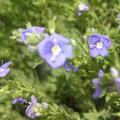
Low growing, drought tolerant evergreen groundcover that becomes covered in tiny sky blue flowers in early spring for about 6 weeks, then sporadically throughout the year. I’ve seen a few twinkling blue blooms in every month of the year. The tiny leaves of V. pectinata are gray-green and tomentose. Allow plenty of room for the spread of this fabulous groundcover; it’ll just keep going and going and going. And you won’t want it to stop.
Buffalograss is North America's only native turfgrass, grows well in clay soils. A warm season grass that spreads by stolons, it is our best selection for low water-use lawns. It will survive very nicely on 15-20 inches of annual precipitation. For green turf summer long, a once a month watering is all that is needed. The common species is short to 4-8 inches, light gray/green to blue/green and goes dormant in fall, greening up again in May. Many newer varieties are being developed for wider blades and deeper green colors, such as Legacy® and Turffalo®.