High Plains Gardening
The gardening website of the Texas High Plains Region




Plants that are native to the American Southwest that exist without supplemental irrigation once established.
Western ironweed is a prairie native to the Great Plains states. Mid-summer to fall deep purple flowers clusters appear at the top of stalks. Ironweed can be invasive, rooting madly down to a foot so control could be difficult. Drought tolerant and cold hardy for the right location.
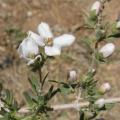
Cliff fendlerbush is another Texas and Southwest native shrub too little used in the xeric landscape. Springtime lifts the cliff fendlerbush above the ordinary into prominence in the landscape. It is said the ravines and arroyos look dotted with snow from a distance, so profuse are the fragrant, creamy white, sometimes with a pink tinge, four petaled flowers in May and June. It's natural element is rocky arroyos (rupicola=rock dweller), cliff ledges and limestone soils with good drainage that average 12-18 inches of moisture with hot sunny days.
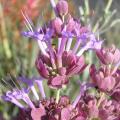
Beautiful xeric sage with aromatic soft gray green leaves, mostly evergreen. Summer to fall blooming with mauve/purple sticky but fragrant flowers. Takes a few years to reach mature height. Requires good drainage and dry soil in the winter. A Plant Select® Plant. Native to California and will grow in the High Desert regions. Cold hardy to Zone 5 and quite heat tolerant.
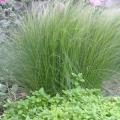
A mid height grass suitable for any low water-use garden, city or country. It does self-seed somewhat, but I hadn’t noticed it to be a problem in a xeric setting (simply remove or transplant them). It's greatest attribute is it's gently flowing nature int he wind. It is native to Texas and the southwest. I saw it growing along the slopes of the Chisos Mountains in Big Bend National Park. It pairs well with yucca, agave, Calylophus and any native shrub.
Yuccas for Texas High Plains Landscapes
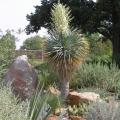
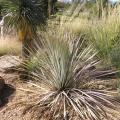
Dasylirion is one of the plants I call a southwest evergreen. Different in appearance from traditional evergreen shrubs, it fulfills the same purpose in native and xeric landscapes. Symmetrical rosette of narrow leaf blades or leaves emanating from the center of the rosette. Barbs lining the margins of the thick pale green leaves give Dasylirion another common name, sawtooth yucca. As Sotol ages, a trunk may form under the rosette and even multiple heads may develop. At maturity, an 8-10 foot tall flower spike ascends from the center where thousands of small creamy white flowers open.
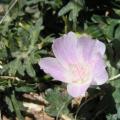
Similar in form to Callirhoe involucrata, Callirhoe alcaeoides 'Logan Calhoun' grows natively from the Midwest to southern plains. While Callirhoe alcaeoides can be pink, to pale pink and pale lilac, 'Logan Calhoun' is pure white. Spreads over an area similar to wine cups, the foliage and flowers are finer. I've found it to be drought tolerant; water monthly to insure continued blooms. Blooms will rest during the heat of the summer and continue following rains or cooler weather.
White flowering zinnia is native to the Southwest and Northern Mexico. A low mounding plant, it becomes completely covered with small white flowers with a central yellow disk, similar to our native prairie zinnia, Zinnia grandiflora. Blooms from June through fall. Desert zinnia is toxic if ingested by humans.
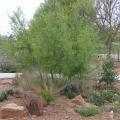
New Mexican privet can be viewed either as a tall shrub or smaller tree. New Mexican privet will flower (tiny yellow) before leafing out with small oval glossy green leaves to be followed with black berries in the fall. Heat and drought tolerant will live in most soils and water-use areas. Attractive taller plant for the home landscape, similar to the yaupon holly in form.
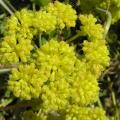
Golden sulfur buckwheat is one of those plants you'll come across while hiking in the West and wonder why it isn't in your garden, its so adorable!
The leaves are gray-green, spatula shaped and woolly underneath, to about 2-3 inches. They form a rosette at the base. In early spring, tall, stout stems extend upward up to 2-3 feet. The bright golden flowers are nearly luminescent, appearing first as ball-like umbels (clusters), then each ball opening up to a circle of golden flowers. As the flowers age, then turn orange.