High Plains Gardening
The gardening website of the Texas High Plains Region




A plant that retains its leaves during all four seasons.
Lavender cotton, or gray santolina is a low mounding woody subshrub that should live on the lean side. Not that it won't overgrow if fed. It will maintain its compact shape in poorer soils without amending or fertilizing. Small silver gray leaves cover the shrub. Tiny yellow button flowers appear in summer. Evergreen, the santolinas are native to the Mediterranean area. Aromatic and edible, it's leaves were used as a flavoring in broths, sauces and grain dishes. Low water-use.
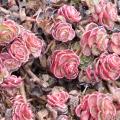
There are many different sedum species and varieties of this delightful spreading groundcover. I took this picture on a garden tour in Angel Fire New Mexico, and have not been able to identify it yet. It is easy to see from the picture how it got its common name, stonecrop. Sedum groundcovers spread nicely in a low to medium water use area of gritty, well drained soil, and will do just fine in afternoon shade.
Green santolina is an evergreen shrub native to the Mediterranean region. Its grass-green color makes it a welcome addition to any landscape. Medium and low water use, cold hardy, sun and heat tolerant, it prefers poorer soil. Aromatic green leaves that resemble those of the cypress. Yellow button flowers in summer.
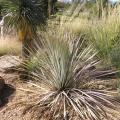
Dasylirion is one of the plants I call a southwest evergreen. Different in appearance from traditional evergreen shrubs, it fulfills the same purpose in native and xeric landscapes. Symmetrical rosette of narrow leaf blades or leaves emanating from the center of the rosette. Barbs lining the margins of the thick pale green leaves give Dasylirion another common name, sawtooth yucca. As Sotol ages, a trunk may form under the rosette and even multiple heads may develop. At maturity, an 8-10 foot tall flower spike ascends from the center where thousands of small creamy white flowers open.
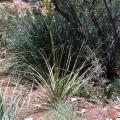
Bear grass is similar in appearance to yucca and clumping grass, but is neither. Usually found growing in high desert areas, along cliffs and rocky slopes. Thin succulent grasslike yellow-green leaves emerge from a trunkless center, are pointed and sharp edged. A plume-like inflorescence with many tiny cream colored flowers emerges early summer. Cold hardy, drought and heat tolerant.