High Plains Gardening
The gardening website of the Texas High Plains Region




Plants are known to be cold hardy to at least -10°F.
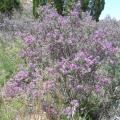
If you find yourself in Palo Duro Canyon at the end of April or beginning of May, the purple haze dotting the cliffsides is feather dalea. Sporadic blooms will open after showers throughout summer, though never as profuse as in springtime. With monthly irrigation in a xeric garden, feather dalea adds color and texture with it's twiggy, but sturdy, appearance. Small purple flowers combined with white plumes carries the haze impression from a distance.
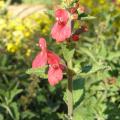
Texas betony is a workhorse of the garden once established, putting on a plethora of scarlet blooms midsummer on. A member of the mint family with square stems, the foliage is fragrant, but the plant is not invasive as classic mints tend to be. Hummingbirds love Texas betony. Though native to the Southwest, it is found in moist crevices and steep, stony places in the mountains in moist, well-drained sand, loam, and clay. Texas betony is said to be cold hardy to -20°, however, I have not found it reliable in returning each winter. Yet, it is worth replanting.
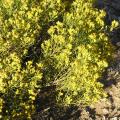
Broom snakeweed is a small mounded subshrub with yellow greenish thread-like leaves, native throughout the Southwest and western half of the North American continent. In the fall, it becomes covered in small golden yellow flowers. Bees and nectar butterflies are attracted to it in numbers. Usually grows to only a foot tall.
Blue grama grass is a short, clumping warm season grass with thin blue green blades that is native throughout the Great Plains and Southwest. Able to grow in poor, dry soils, blue grama grass needs only about 12 inches of annual precipitation to survive. If seeded thick enough and with moderate irrigation, blue grama will form turf. Once establish, reduce to monthly supplemental irrigation, and mow not more frequently than monthly to a height of 4 inches. One advantage of blue grama over buffalograss is the speed of germination; it will germinate in 5-7 days.
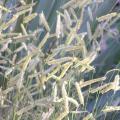
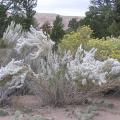
Winterfat, formerly Ceratoides lanata, is a drought and heat tolerant that normally is found in poor, alkaline soils throughout the Southwest in grasslands and scrublands. Winterfat is a low rounded woody shrub with pale blue green to gray leaves. The distinctive characteristic is the long wooly seed stalk it puts up in the summer. Towards winter, the stalk appears to be covered with wool.
Grayleaf cotoneaster is a wonderful low growing shrub for the xeric garden. Evergreen or semi-evergreen in colder winters, it provides good winter interest, along with the other seasons. Small oval shaped silver/gray leaves cover the many arching branches. Tiny white flowers appear in late spring followed by red berries in late fall and winter. Low water use once established.