High Plains Gardening
The gardening website of the Texas High Plains Region




SW native American plants are considered to be native if they were found growing in southwest United States prior to European settlement.
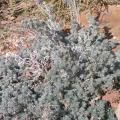
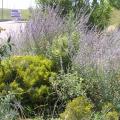
Lower growing Southwestern native shrub, both cold and heat tolerant. Finely cut greenish silver leaves. Flower stalks with insignificant flowers. Grows best in soils with good drainage. Will grow in heavy clay soil if grown among grasses.
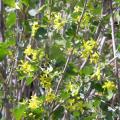
Golden current makes an attractive taller shrub at the edge of a lawn or vegetable garden, positioned to catch extra irrigation water. For three stunning weeks in spring it will be covered with tiny yellow flowers. I planted two in 2008, and have yet to notice the tasty berries, red currents, for which they are known. Quite cold hardy, if placed in full sun, it'll need twice a month watering to survive, or in half or more shade, once a month watering is sufficient. Multi stem shrub with small, rounded leaves with cut edges makes an attractive barrier or hedge plant.
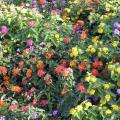
Lantana urticoides (horrida) is a native perennial, and cold hardy for most of the state, except for areas in the Texas Panhandle. In the Panhandle, several species of Lantana are sold as summer bedding plants. Blooms prolifically summer and fall. Colors normally available are red, red and yellow, yellow, white and purple or mauve. In rare cases they may winter over. In areas south, lantana will grow into a shrub. The blue/black fruit clusters are poisonous.
Attracts butterflies.
Curl leaf mountain mahogany is a medium height evergreen shrub native to elevations between 5000-10,000 feet throughout the Southwest. Small oval shaped dark green leaves lightly curl under at the margins are evergreen and aromatic. Small yellow flowers in spring time that develop into grain size fruits with a feathery tail attached to one end (similar to other mountain mahoganies). Slow growing and long lived, it can reach a height of 20 feet or more, but is more typically 6-12 feet. Densely branched. Cold hardy, drought and heat tolerant.
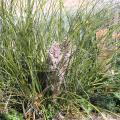
Texas beargrass is a grass-like perennial evergreen plant native in rocky and limestone soils from central Texas to the upper Rio Grande Plains and west to the Trans-Pecos and into S.E. Arizona. Not a true grass, Texas sacahuista is a member of the lily (Liliaceae ) family. It flowers in Amarillo in early April. A short flowering stem barely rises above the many thin leaves. The flowers appear rose or reddish on the outside before opening, are numerous, white to cream colored forming dense vertical clusters.
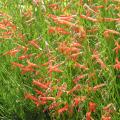
A long-lived evergreen penstemon for the average bed or border. Small orange red tubular flowers attract hummingbirds, as do most red tubular flowers. Low growing and longer flowering than most, especially the more mature the specimen.
After several years, the pine needle like foliage can resemble a miniature bonsai. Pineleaf penstemon is also a must-have for the low water-use bed or border or rock garden because of its evergreen foliage and longer blooming nature. In late summer, snip off the dried, spent flower heads; some re-blooming may occur.
Black dalea, an autumn blooming southwest native shrub, should be used more in the home xeric landscape. Growing only to about 3 feet, black dalea spreads out with thin, wiry branches and small, green, compound leaves. The shrub becomes completely covered with tiny purple flowers as to be enshrouded in a purple cloud.
Many references are unsure of its cold hardiness to zero, and it had thrived nicely in my city garden in Amarillo. However, it does not seem to be reliably cold hardy. It's a beautiful shrub that provides stunning late fall color that is worth replanting.
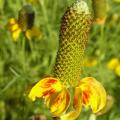
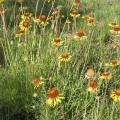
You can't have just one. As soon as you plant one, you'll have a drift, then a sweep, then a field if you have the space. But I still don't consider the prairie coneflower to be invasive, merely pleasant. Next to the Indian Blanket, the Mexican Hat shouts Southwest prairies. And its a tough hombre. If your stand becomes too dense or too much, just weed some out. They're adaptable to most native soils and will thrive on available or once a month supplementation. Coneflowers bloom yellow, reddish or brown late spring into fall and make an attractive display when mixed.
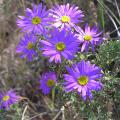
Tansy aster is an annual native to the Southwest and throughout the Plains even into Canada. Fernlike, or tansy-like (tannacetifolia) light green foliage with beautiful aster-like lavender flowers with yellow disks about 1 1/2 to 2 inches across. Blooms from late spring through fall. A once a month watering will keep the blooms coming throughout the summer. It will keep its compact shape in lean, poor soil but will become much larger in well amended soil. Minimal amending is recommended. Tansy aster is another example of our natives plants giving so much, asking so little in return.
Mountain mahogany is native to the Texas Panhandle and throughout the Southwest, found in elevations from 3000-9500 ft. Another common name is Alderleaf mountain mahogany, because its leaves resemble that of an alder. Mountain mahogany, whose wood is very hard (Palo Duro) is found in Palo Duro Canyon. Extremely drought tolerant, it will survive on 10 inches of rainfall. An aromatic shrub with shredding reddish bark, but can grow to tree size. Mountain mahogany's flowers are small, rayless and insignificant, as they are in the other species.
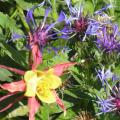
Many Aquilegia’s are native to the U.S. Golden columbine, Aquilegia chrysantha is a Texas and southwest native, has yellow flowers and can take more sun than some varieties. McKana's Giant is the hybrid columbine most often sold. Large beautiful bi-colored flowers dazzle in woodland and shady area. Rocky Mountain columbine, Aquelegia caerulea; and wild columbine, A. canadensis, are other common columbines. Rocky Mountain columbine is the state flower of Colorado.
‘Mersea Yellow’ is similar to the orange red pineleaf penstemon in culture, except for requiring a bit more water. Native perennial to the Southwest. Its leaves are lighter green, but still evergreen, without the tinge of mahogany in winter. ‘Mersea Yellow’ is an excellent selection for the medium water-use zones of your landscape. One of the few yellow flowering penstemons.
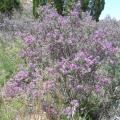
If you find yourself in Palo Duro Canyon at the end of April or beginning of May, the purple haze dotting the cliffsides is feather dalea. Sporadic blooms will open after showers throughout summer, though never as profuse as in springtime. With monthly irrigation in a xeric garden, feather dalea adds color and texture with it's twiggy, but sturdy, appearance. Small purple flowers combined with white plumes carries the haze impression from a distance.
Another tough and pretty wildflower that populates a wide area from the plains of Oklahoma down to the Chihuahua Desert and over to Colorado and Utah. Leaves are lower near the base of the plant from which stems emerge and bloom in late spring to early summer. Yellow rays with a red to brownish center.
Bigelow's tansyaster is easy to confuse with Tahoka daisy but is not as showy. Bigelow's aster is a fall blooming biennial, with far fewer purple rays and a smaller, yellow brown center disk. It populates plains in Colorado, Arizona and New Mexico. In the fall, whole fields will wear a purple haze due to this tansyaster.
Turpentine shrub is an evergreen shrub native to the southern parts of the Southwest, and only marginally cold hardy on the Caprock. It will survive when in a sheltered location and soil with excellent drainage, along rocky cliffs, outcrops and arroyos. Avoid compact clay soil, or amend clay soil very well for drainage with inorganic amendments. Yellow autumn flowers.
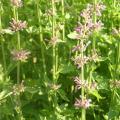
Herbaceous perennial. Fragrant hummingbird plant belonging to the mint family (Lamiaceae). Limited reseeding. Does better in afternoon shade. Locate in a transition area between medium and low water use. Leave plant and flower stalks standing in the fall, the plant does better trimmed back at the beginning of March.
Native perennial wildflower that will bloom periodically from spring into fall (presumably when there is adequate moisture). I have seen it many times in nature in the Texas Panhandle and West Texas. After the flowers have peaked, they do not fall off, but turn light and papery. They make a good dried flower. Reseeds!
This wildflower is toxic to sheep and possibly cattle. Humans should not eat any part of this plant. The flowers are fragrant and are attractive to bees, birds and butterflies.
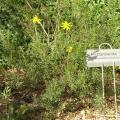
Dark green, semi-evergreen aromatic leaves are the feature most prized, along with the tiny yellow daisy-like flowers that bloom spring to fall. Damianita prefers full sun and lean soil and does well in heat and temperatures to zero degrees. Daminaita will lose its leaves in cold winters.
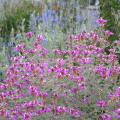
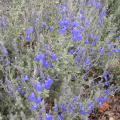
Mexican blue sage is a native of Mexico and in many references labels it cold hardy to USDA Zone 8, however, it has wintered over in Amarillo many years now, even in full northern exposure. It has died back to the ground once or twice, but comes back up from the roots. If good to well drained soil is provided, it should do fine. And I hope you can provide that, as Mexican blue sage is one of my top plants to include in xeric gardens. True bright blue flowers bloom summer and fall with once a month watering. Butterflies are attracted to it. Indispensable.
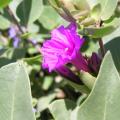
Rounded mounds of green leaves on multi-forked stems put forth multitudes of fragrant purple/magenta flowers from summer into autumn. Flowers open in late afternoon (perhaps around four o'clock) and close in early morning. Cold hardy and heat and drought tolerant, after freezing in the fall, the top growth breaks away. Desert four o'clock emerges in the spring from a large root. Will not transplant well once established. Southwest native perennial is usually found in somewhat shaded areas.
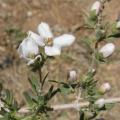
Cliff fendlerbush is another Texas and Southwest native shrub too little used in the xeric landscape. Springtime lifts the cliff fendlerbush above the ordinary into prominence in the landscape. It is said the ravines and arroyos look dotted with snow from a distance, so profuse are the fragrant, creamy white, sometimes with a pink tinge, four petaled flowers in May and June. It's natural element is rocky arroyos (rupicola=rock dweller), cliff ledges and limestone soils with good drainage that average 12-18 inches of moisture with hot sunny days.
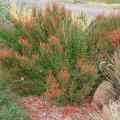
A native to Texas, flame acanthus loves the heat and full sun! A hummingbird and butterfly plant. Does well in poor soil. May only be cold hardy to Zone 7, however, it has come back for several years in the Panhandle. Grows rapidly and will flower the first year, if you must replant, this is still a good choice for mid to late summer and autumn flowers. Re-seeds some, transplant them early as their roots grow deep.There is another variety with light pumpkin colored flowers, but this one does not bloom as prolificly.
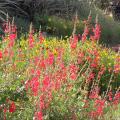
The flowers of Salvia darcyi are similar in appearance to Salvia greggii, however the shrub itself is more herbaceous than shrubby. I know of no common name for S. dacryi. Some sources say it is cold hardy to Zone 7, however it thrives in Denver Botanical Garden’s Zone 5. S. darcyi is native to the mountains of Northern Mexico and will do well in amended soil. Hummingbirds love it.
I have it planted in my xeristrip for a number of years. It will flower more vigorously with irrigation everyother week, when needed during hot drought years.
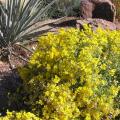
I prefer dwarf chamisa to the full size species. Dwarf Chamisa fits better into home xeric areas and has green leaves, rather than gray or silvery. It's silvery stems combine well with its green foliage and yellow gold flowers. Although given the species and variety name "nauseosus" it has a pleasant fragrance. Dwarf chamisa blooms profusely in late summer and will readily re-seed.