High Plains Gardening
The gardening website of the Texas High Plains Region




SW native American plants are considered to be native if they were found growing in southwest United States prior to European settlement.
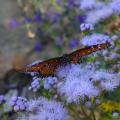
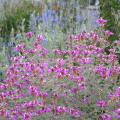
Gregg's mist flower is a Southwest native for the partly shaded bed medium to low water-use bed. It's a butterfly magnet, particularly for the Monarch butterfly which passes through about the same time the mist flower is bloom in late summer into fall. Masses of lavender blue flowers top the plant for which it gets it names, the appearance of blue mist. Frequently, butterflies will be seen topping the flowers. Gregg's mist flowers will spread by roots, allow it some room.
Utah serviceberry is a quite beautiful shrub extending from the Southwestern states northward throughout the Rocky Mountains and through various ecosystems between 4000 and 8000 ft in elevation. Deep green leaves, large oval shaped and toothed at the margins, many intricately branched, smooth gray to maroon bark. Large white flowers with five widely spaced petals open in May and June. Berries appear in the summer, ripening to pink, then red, then finally dark blue. Leaves turn red and orange in the fall.
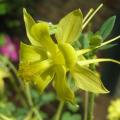
Delicate and fragile in appearance, columbines are some of the most durable, versatile plants in the West. Aquilegia chrysantha is the Texas native columbine, happy in both sun or shade, moist areas or dry. Aquilegia chrysantha is native to the Chihuahuan and Sonoran Desert canyons from west Texas, southern New Mexico, southern Utah, and Arizona south into Sonora, Coahuila, and Nuevo Leon along with a disconnected population in southern Colorado.
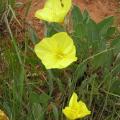
Gorgeous! Luscious goblet shaped lemon yellow flowers on this native wildflower that also develops elongated seed capsules. The lighter, silvery sheen of the leaves distinguishes the O. macrocarpa var. incana subspecies, and is also an evening to morning bloomer.
Wagons Ho! Rugged, ragged and windblown -- a true picture of the western and southwestern landscape. If you have a skeleton of a steer's head, now is the time to use it, along with that wagon wheel. Sometimes referred to as the western sage.
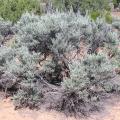
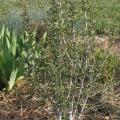
Big sagebrush is a coarse, many-branched, aromatic, pale-grey shrub with yellow flowers and light silvery-grey foliage. It flowers in late summer to early fall. The leaves are wedge-shaped with three lobes.
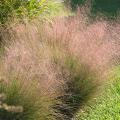
Warm season native clumping ornamental grass that is well suited to the transition zone between turf and flower bed. Medium to blueish green thin grass blades form a low to medium size clump, medium water-use zone. In late September, it sends plumes upward that give the appearance of a deep pink haze or mist. There are several new selections of Gulf Coast muhly, thankfully, to choose from. Be sure to pay attention to the cold hardiness for your area and you won't be disappointed.
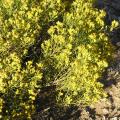
Broom snakeweed is a small mounded subshrub with yellow greenish thread-like leaves, native throughout the Southwest and western half of the North American continent. In the fall, it becomes covered in small golden yellow flowers. Bees and nectar butterflies are attracted to it in numbers. Usually grows to only a foot tall.
Littleleaf mountain mahogany is the shortest of the mountain mahoganies usually sold. Small, narrow, leathery looking evergreen leaves on many intricate branches. Small yellow flowers in springtime and feathery seed plumes in the fall. The shrub is densely branched and slow growing.
Golden sulfur buckwheat is one of those plants you'll come across while hiking in the West and wonder why it isn't in your garden, its so adorable!
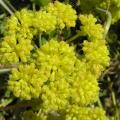
The leaves are gray-green, spatula shaped and woolly underneath, to about 2-3 inches. They form a rosette at the base. In early spring, tall, stout stems extend upward up to 2-3 feet. The bright golden flowers are nearly luminescent, appearing first as ball-like umbels (clusters), then each ball opening up to a circle of golden flowers. As the flowers age, then turn orange.
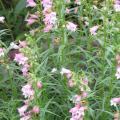
‘Red Rocks’ is another hybrid cultivar, named for the Denver, Colorado red sandstone area and amphitheater. P. 'Red Rocks' is highly suitable for the average garden, rather than a specialized penstemon bed. Again, do not deadhead unless reblooming has occurred and you desire a tidier appearance. Don’t over water or over amend the soil, but it will thrive companionably with other medium water-use plants.
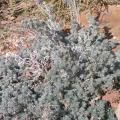
Lower growing Southwestern native shrub, both cold and heat tolerant. Finely cut greenish silver leaves. Flower stalks with insignificant flowers. Grows best in soils with good drainage. Will grow in heavy clay soil if grown among grasses.
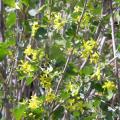
Golden current makes an attractive taller shrub at the edge of a lawn or vegetable garden, positioned to catch extra irrigation water. For three stunning weeks in spring it will be covered with tiny yellow flowers. I planted two in 2008, and have yet to notice the tasty berries, red currents, for which they are known. Quite cold hardy, if placed in full sun, it'll need twice a month watering to survive, or in half or more shade, once a month watering is sufficient. Multi stem shrub with small, rounded leaves with cut edges makes an attractive barrier or hedge plant.
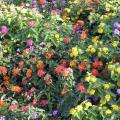
Lantana urticoides (horrida) is a native perennial, and cold hardy for most of the state, except for areas in the Texas Panhandle. In the Panhandle, several species of Lantana are sold as summer bedding plants. Blooms prolifically summer and fall. Colors normally available are red, red and yellow, yellow, white and purple or mauve. In rare cases they may winter over. In areas south, lantana will grow into a shrub. The blue/black fruit clusters are poisonous.
Attracts butterflies.
Curl leaf mountain mahogany is a medium height evergreen shrub native to elevations between 5000-10,000 feet throughout the Southwest. Small oval shaped dark green leaves lightly curl under at the margins are evergreen and aromatic. Small yellow flowers in spring time that develop into grain size fruits with a feathery tail attached to one end (similar to other mountain mahoganies). Slow growing and long lived, it can reach a height of 20 feet or more, but is more typically 6-12 feet. Densely branched. Cold hardy, drought and heat tolerant.
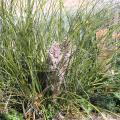
Texas beargrass is a grass-like perennial evergreen plant native in rocky and limestone soils from central Texas to the upper Rio Grande Plains and west to the Trans-Pecos and into S.E. Arizona. Not a true grass, Texas sacahuista is a member of the lily (Liliaceae ) family. It flowers in Amarillo in early April. A short flowering stem barely rises above the many thin leaves. The flowers appear rose or reddish on the outside before opening, are numerous, white to cream colored forming dense vertical clusters.
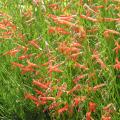
A long-lived evergreen penstemon for the average bed or border. Small orange red tubular flowers attract hummingbirds, as do most red tubular flowers. Low growing and longer flowering than most, especially the more mature the specimen.
After several years, the pine needle like foliage can resemble a miniature bonsai. Pineleaf penstemon is also a must-have for the low water-use bed or border or rock garden because of its evergreen foliage and longer blooming nature. In late summer, snip off the dried, spent flower heads; some re-blooming may occur.
Black dalea, an autumn blooming southwest native shrub, should be used more in the home xeric landscape. Growing only to about 3 feet, black dalea spreads out with thin, wiry branches and small, green, compound leaves. The shrub becomes completely covered with tiny purple flowers as to be enshrouded in a purple cloud.
Many references are unsure of its cold hardiness to zero, and it had thrived nicely in my city garden in Amarillo. However, it does not seem to be reliably cold hardy. It's a beautiful shrub that provides stunning late fall color that is worth replanting.
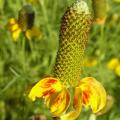
You can't have just one. As soon as you plant one, you'll have a drift, then a sweep, then a field if you have the space. But I still don't consider the prairie coneflower to be invasive, merely pleasant. Next to the Indian Blanket, the Mexican Hat shouts Southwest prairies. And its a tough hombre. If your stand becomes too dense or too much, just weed some out. They're adaptable to most native soils and will thrive on available or once a month supplementation. Coneflowers bloom yellow, reddish or brown late spring into fall and make an attractive display when mixed.
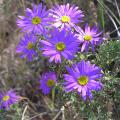
Tansy aster is an annual native to the Southwest and throughout the Plains even into Canada. Fernlike, or tansy-like (tannacetifolia) light green foliage with beautiful aster-like lavender flowers with yellow disks about 1 1/2 to 2 inches across. Blooms from late spring through fall. A once a month watering will keep the blooms coming throughout the summer. It will keep its compact shape in lean, poor soil but will become much larger in well amended soil. Minimal amending is recommended. Tansy aster is another example of our natives plants giving so much, asking so little in return.
Mountain mahogany is native to the Texas Panhandle and throughout the Southwest, found in elevations from 3000-9500 ft. Another common name is Alderleaf mountain mahogany, because its leaves resemble that of an alder. Mountain mahogany, whose wood is very hard (Palo Duro) is found in Palo Duro Canyon. Extremely drought tolerant, it will survive on 10 inches of rainfall. An aromatic shrub with shredding reddish bark, but can grow to tree size. Mountain mahogany's flowers are small, rayless and insignificant, as they are in the other species.