High Plains Gardening
The gardening website of the Texas High Plains Region




SW native American plants are considered to be native if they were found growing in southwest United States prior to European settlement.
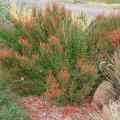
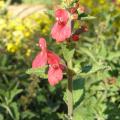
A native to Texas, flame acanthus loves the heat and full sun! A hummingbird and butterfly plant. Does well in poor soil. May only be cold hardy to Zone 7, however, it has come back for several years in the Panhandle. Grows rapidly and will flower the first year, if you must replant, this is still a good choice for mid to late summer and autumn flowers. Re-seeds some, transplant them early as their roots grow deep.There is another variety with light pumpkin colored flowers, but this one does not bloom as prolificly.
The flowers of Salvia darcyi are similar in appearance to Salvia greggii, however the shrub itself is more herbaceous than shrubby. I know of no common name for S. dacryi. Some sources say it is cold hardy to Zone 7, however it thrives in Denver Botanical Garden’s Zone 5. S. darcyi is native to the mountains of Northern Mexico and will do well in amended soil. Hummingbirds love it.
I have it planted in my xeristrip for a number of years. It will flower more vigorously with irrigation everyother week, when needed during hot drought years.
I prefer dwarf chamisa to the full size species. Dwarf Chamisa fits better into home xeric areas and has green leaves, rather than gray or silvery. It's silvery stems combine well with its green foliage and yellow gold flowers. Although given the species and variety name "nauseosus" it has a pleasant fragrance. Dwarf chamisa blooms profusely in late summer and will readily re-seed.
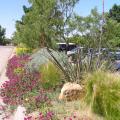
Texas red yucca is technically not a yucca, but has many of the same qualities as yuccas. Thick, succulent dark olive green leaves grow out of the base, as it is stemless. The coral red flowers appear at the top of a long raceme, often 4-6 feet tall. 'Yellow' and 'Red' blooming yuccas are also available. Although it's natural range is north eastern Mexico and West Texas, it is cold hardy throughout much of the Southwest. Allow for sharp drainage in moister climates to prevent root rot.
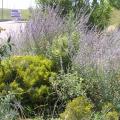
Purple or desert sage prefers leaner, quick draining soils. It is said to grow 2-3 feet tall and deeply branched with silver gray foliage and a profusion of violet bluish flowers atop spikes in late spring and summer. Low water-use, but does better with once a month irrigation. One of the finest flowers of the desert, it is the sage of Riders of the Purple Sage, by Zane Grey. Grows throughout the Great Basin Desert.
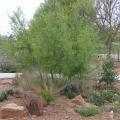
New Mexican privet can be viewed either as a tall shrub or smaller tree. New Mexican privet will flower (tiny yellow) before leafing out with small oval glossy green leaves to be followed with black berries in the fall. Heat and drought tolerant will live in most soils and water-use areas. Attractive taller plant for the home landscape, similar to the yaupon holly in form.
Native to the Texas Panhandle, the south and into northern Mexico. Strong chocolate scent fills the morning air. Xeric herbaceous perennial with a deep taproot. Flower closes up during the heat of the day, staying open during more moderate days. Good choice for naturalizing. Best to keep soil on the lean side, will grow leggy in amended soil. Reseeding profusely. Cut back flower to base at end of June if it becomes too leggy. Within weeks, it'll grow back and begin flowering again.
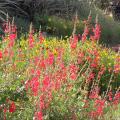
If I had to pick my favorite plant, this is it. Long blooming and drought tolerant with only minimal maintenance of late winter cutting back, and maybe a bloom pick-me-up deadheading at mid summer. It will also re seed some so you’ll have more of them the next year. It’s fragrance is light and pleasantly of sage. Salvia greggiis are native to Texas in the Kerrville area. It is my favorite, but not the absolutely perfect plant. The stems are quite brittle and very easily break or snap off, even when you’re carefully weeding around it.
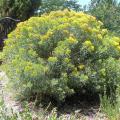
Chamisa or rabbitbrush is a medium tall shrub with blue-green stems that produce clusters of golden yellow flowers from September throughout fall, very showy in the landscape. Matted hairs on thin leaves cast a silvery appearance. Native throughout the southwest, in warmer climates it is evergreen. The official name has been changed to Ericamera nauseosa, but is still referred to as Chrysothamnus (meaning golden bush). Seeds prolifically -- is a good pass-along plant to friends, neighbors, relatives and passersby.
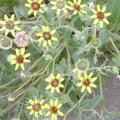
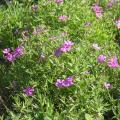
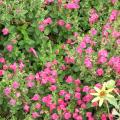
Santa Fe phlox is rarely available even at native plant nurseries, but when it is, don't pass it up. Sun loving and drought tolerant, the Santa Fe phlox blooms late spring throughout the summer with once a month watering. Five petaled, small pink flowers about an inch across with a small white eye can cover the plant. Native to canyons, mesas, and rocky desert slopes from West Texas to southeastern Arizona and into northern Mexico. Seeds of the phlox pop out when they are mature, making seed collection and propagation difficult.
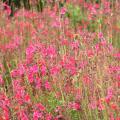
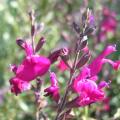
Raspberry hybrid bush sage is very similar in appearance to Salvia greggii, blooming April through November. It's two-lipped flowers with a pleasant deep raspberry color, and the mahogany calyces contrast nicely. 'Raspberry Delight' is a hybrid cross between Salvia greggii 'Furman's Red' and and a high altitude collection of Salvia microphylla from central Arizona. Woody and brittle branches with small oval shaped leaves that hang on to the plant sometimes through the winter, as they do on S. greggii.
One-seed juniper is the juniper found in the dry hills and mesas throughout our area and the Southwest in elevations from 3500 to 8000'. Slow growing on top, it's tap root grows quickly and deeply, making them very difficult to transplant. It's habit is shrubby with several stems and branches growing low to the ground, making it a good habitat plant. Extremely drought, heat and cold tolerant.
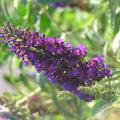
Butterfly bush is a perennial shrub that comes in many colors from white, yellow, pink, rose, to mauve and deep purple. Native to China and is available in many different hybrids, cultivars or varieties. Quite fragrant, attracts butterflies. Butterfly bush needs very good drainage, it will not tolerant wet clay soil. It will grow in poor soil with good drainage. Butterfly bush trives quite well in low water-use areas. Alternate spelling is Buddleja. Not invasive in the Texas Panhandle.Several species are native to parts of Texas and Mexico. B.
A Plant Select Plant for 2004, Pink Texas Skullcap has often been listed as a Zone 7 plant, but it is reliably cold hardy in Zone 6 and in protected Zone 5b sights. I’ve grown it in my xeristrip since 2000. Long blooming with no maintenance ever performed. These low growing, mounding skullcaps are excellent for Panhandle xeristrips and rock gardens. Native varieties are S. drummondii, and S. resinosa. The hybrid cultivar, S. x ‘Violet Cloud’, introduced by High Country Gardens, is an excellent violet skullcap as well as the natives.
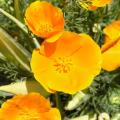
Most notable in the meadows and fields of California, the California poppy grows throughout the southwest. Considered to be both annual and perennial, it either comes back the next year or it reseeds. Once you have a stand established, it should continue in your landscape, but not invasively so. This past summer of 2012, my California poppies bloomed in both the spring and our unusual fall. Blooms in April and May. Finely cut blue-green foliage make an attract plant outside the bloom period. The foliage should die back in summer.
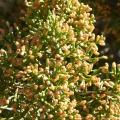
Shadscale lives in alkaline caliche soil in most of its native range throughout the Southwest and has a high tolerance of saline or sodic soils. Given improved soil conditions, it will grow larger. Do not improve the soil to insure it keeps its neat, compact shape. Shadscale blooms yellow flowers in early summer which mature into seed heads. Its silver-gray leaves are semi-evergreen.
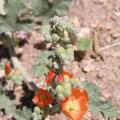
Gooseberryleaf globemallow is very close in appearance to scarlet globemallow, Sphaeralcea coccinea, but much taller, up over 2 feet. The leaves are silver green and hairy, resembling the leaves of the current shrubs in shape, so named from the family name of currents and gooseberries, Grossulariaceae. Flowers are orange in color and bloom from May and June, sometimes later in the summer. Native to hot, dry areas semi-arid regions throughout the Southwest and the Great Basin Desert. Prefers good to sharp drainage.
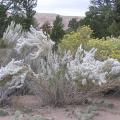
Winterfat, formerly Ceratoides lanata, is a drought and heat tolerant that normally is found in poor, alkaline soils throughout the Southwest in grasslands and scrublands. Winterfat is a low rounded woody shrub with pale blue green to gray leaves. The distinctive characteristic is the long wooly seed stalk it puts up in the summer. Towards winter, the stalk appears to be covered with wool.
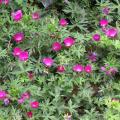
Please notice the beautiful deeply, palmately lobed green leaves, similar to geraniums. Callirhoe involucrata makes a good drought tolerant ground cover, however, it is not evergreen. The cup shaped flowers are usually rose or magenta, however, native plants may exhibit lighter colors. As temperatures rise above 90 - 95 degrees, flowering will stop until temperatures cool. A Plant Select Plant. Give this plant plenty of room as it smothers plants it grows over. C. involucrata 'Logan Calhoun' is a white flowering poppy mallow. C. involucrata v.
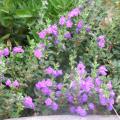
A new hybrid skullcap from High Country Gardens. A cross between two native skullcaps, Violet Cloud likes the soil lean and well drained. A sparkling addition for the rock garden, xeristrip and any low water-use area. Additional watering is required during establishment the first year, after that, it should be drought tolerant.
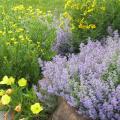
The Calylophus genus is one of the best Southwest native plants for Panhandle gardens. Heat and drought tolerant, long blooming with little to no care, what garden would be without it? Sunny yellow 4 petaled sundrop flowers bloom in an explosion in spring, and respectably during the remaining growing season, especially when given a once a month inch of water during drought conditions. Each individual flower lasts only a day, tight compact mounds sport the orange spent blooms as well as the new bright yellow flower.
Texas betony is a workhorse of the garden once established, putting on a plethora of scarlet blooms midsummer on. A member of the mint family with square stems, the foliage is fragrant, but the plant is not invasive as classic mints tend to be. Hummingbirds love Texas betony. Though native to the Southwest, it is found in moist crevices and steep, stony places in the mountains in moist, well-drained sand, loam, and clay. Texas betony is said to be cold hardy to -20°, however, I have not found it reliable in returning each winter. Yet, it is worth replanting.
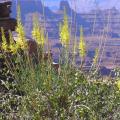
Elegant and stately desert perennial. Soft light blue green leaves. Stalks can tower above desert shrubs to 5-6 feet, but usually 2-4 feet, with racemes of yellow flowers similar to cleome or spider plant flowers in springtime. Requires excellent drainage and lean soils. Thrives on selenium rich soils. Native to canyonlands in SW U.S.
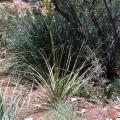
Bear grass is similar in appearance to yucca and clumping grass, but is neither. Usually found growing in high desert areas, along cliffs and rocky slopes. Thin succulent grasslike yellow-green leaves emerge from a trunkless center, are pointed and sharp edged. A plume-like inflorescence with many tiny cream colored flowers emerges early summer. Cold hardy, drought and heat tolerant.
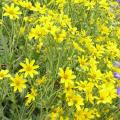
First class native wildflower for your low water-use location whether you live in the city or country. No soil amending is even needed for Engelman's daisy, but you might want to improve the drainage if you soil is compact, or amend with some organic matter for caliche soil. Toowell amended soil will cause E. pinnatifida to grow too tall and gangly. If this happens, cut down nearly to the ground at the end of June, or mid July. It will grow back and begin flowering within 3 - 4 weeks. Will reseed some.