High Plains Gardening
The gardening website of the Texas High Plains Region




SW native American plants are considered to be native if they were found growing in southwest United States prior to European settlement.
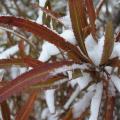
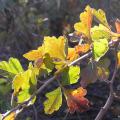
Arizona rosewood is one of the few native evergreen trees or tall shrubs that are low water-use. Underused in the Texas Panhandle, mostly due to lack of availability. But with searching in Albuquerque or Santa Fe, one should be able to locate a specimen. Faster growing than the Chisos rosewood. Long slender, serrated, glossy green leaves with white flowers in summer.
Blue grama grass is a short, clumping warm season grass with thin blue green blades that is native throughout the Great Plains and Southwest. Able to grow in poor, dry soils, blue grama grass needs only about 12 inches of annual precipitation to survive. If seeded thick enough and with moderate irrigation, blue grama will form turf. Once establish, reduce to monthly supplemental irrigation, and mow not more frequently than monthly to a height of 4 inches. One advantage of blue grama over buffalograss is the speed of germination; it will germinate in 5-7 days.
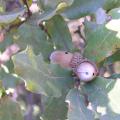
Gambrel oak is a common native oak species throughout the Rocky Mountain foothills and here in the Texas Panhandle as well. Often times it grows more to a tall shrub, with sufficient moisture it can mature into a small tree. Beautiful somewhat glossy lobed green leaves to 3-5 inches long. Beautiful fall foliage. Will put out a profuse amount of acorns. Gambrel oak can form a thicket. Cold, heat and drought tolerant. Inconspicous tiny red flowers appear shortly after leafing and are normally hid by the leaves.
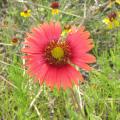
Our showiest native wildflower; an annual. Little care required. Grows along roadsides and in natural areas throughout our region. Gaillardias are popular these days, with many new introductions all the time. G. pulchella is a good choice for seeding in prairie areas with other native grasses and wildflowers.
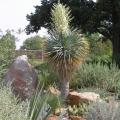
Yuccas for Texas High Plains Landscapes
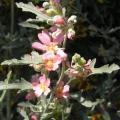
Desert globemallow is one of those native plants that keeps on giving, asking so little in return and is a worthy addition to any native or xeric garden. Typically, desert globemallow sports pretty pink flowers. though some plants will bloom white, coral or lavender. Whatever color, they are worth the addition to your sunny and dry landscape for their pleasant cheery nature. Similar to appearane to S. coccinea, a coral blooming species.
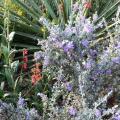
Big Bend silverleaf is the most cold hardy of the Leucophyllums and has wintered over in Amarillo, Zone 7, for 5 years so far. Possibly cold hardy to Zone 6. It is hard to beat a more attractive summer blooming shrub for small xeric spaces. After summer rainfalls, Big Bend silverleaf, native to the Big Bend National Park area, becomes covered in silver blue flowers that twinkle like jewels among its silvery gray leaves. Hard to find, it's worth searching for.
Buffalograss is North America's only native turfgrass, grows well in clay soils. A warm season grass that spreads by stolons, it is our best selection for low water-use lawns. It will survive very nicely on 15-20 inches of annual precipitation. For green turf summer long, a once a month watering is all that is needed. The common species is short to 4-8 inches, light gray/green to blue/green and goes dormant in fall, greening up again in May. Many newer varieties are being developed for wider blades and deeper green colors, such as Legacy® and Turffalo®.
Shrub live oak, often a medium size shrub, is native to the Southwest and the Texas Panhandle typically found in canyons, rocky cliffs and hillsides. Sometimes called a holly oak, the leaves are 3-4 inches long, spine-tipped and holly shaped bluish green leaves. It is prolific in putting out acorns. Cold hardy, heat and drought tolerant.
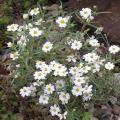
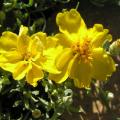
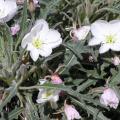
Native wildflower that likes it lean and mean. Over watering and well amended soil will usually cause Blackfoot daisy to die a premature death, even for a short lived perennial, such as it is. It would be an ideal border plant, similar to alyssum, if not for its tendency to move about where it will (that is, die where you plant it and seed somewhere else). Still, it’s worth a try. Our Panhandle xeric gardens should never be without Blackfoot Daisy. In fact, once you plant Blackfoot daisy and let it seed, you should never be without it (and that’s a good thing).
Grown extensively throughout the southwest, I don’t know why it has taken so long for this plant to become available in the Panhandle, especially since it is cold hardy to Zone 5.
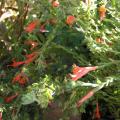
It is a bit slow to become established, and late in coming out in the springtime – have patience and place a marker so it’s not forgotten and weeded up. Note: Early spring-emerging plant may look similar to bindweed. It is best to plant this wild fuchsia in spring, rather than the fall. I noticed better success with quart to gallon size plants.
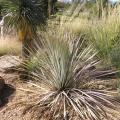
Dasylirion is one of the plants I call a southwest evergreen. Different in appearance from traditional evergreen shrubs, it fulfills the same purpose in native and xeric landscapes. Symmetrical rosette of narrow leaf blades or leaves emanating from the center of the rosette. Barbs lining the margins of the thick pale green leaves give Dasylirion another common name, sawtooth yucca. As Sotol ages, a trunk may form under the rosette and even multiple heads may develop. At maturity, an 8-10 foot tall flower spike ascends from the center where thousands of small creamy white flowers open.
Agaves are striking and architectural Southwest native plants and are included in a group of plants I term Southwest evergreens. They are unusual in that at maturity, they only flower once, and then die. for this reason, some classify them as multiannual, rather than perennial. However, as they common name suggests, it takes many years before they flower. Leaves of the Agave are arranged in a spiral beginning from a near invisible stem, forming a rosette.Agaves vary in size from 4-6 inches to larger than man-size.
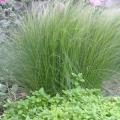
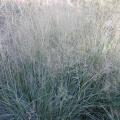
Sand lovegrass is a warm season bunch grass typically found in sandy soils east of the Rockies over a wide range of the U.S. The grass clumps themselves are usually 12-18" tall with the plumes rising to 3-4 feet. Will grow in clay and poorer soils. Very pleasing wispy, arching habit with a soft sway and rustle in the wind. Can grow in partial shade. Seed heads are somewhat purple, fine textured. Will reseed. Low or no water-use.
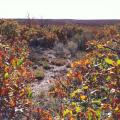
Three leaf sumac is medium height woody shrub native to the Texas Panhandle and throughout the Southwest. Three distinctive cleft and lobed leaves (trifoliate) are medium to dark green. Small greenish yellow flowers in spring are followed by tart red berries in summer, which are used to make a lemonade-like drink. The shrub's flowers have a pleasant fragrance, even though it is called skunkbush by some. Beautiful golden and reddish fall foliage. Cold hardy to Zone 4, yet extremely heat and drought tolerant. Prefers sandy and well drained soils.
A mid height grass suitable for any low water-use garden, city or country. It does self-seed somewhat, but I hadn’t noticed it to be a problem in a xeric setting (simply remove or transplant them). It's greatest attribute is it's gently flowing nature int he wind. It is native to Texas and the southwest. I saw it growing along the slopes of the Chisos Mountains in Big Bend National Park. It pairs well with yucca, agave, Calylophus and any native shrub.
Not our old fashioned garden zinnia. Zinnia grandiflora is the native zinnia for most of the Midwest, West and Southwestern parts of the United States. So widespread a wildflower, each region has named it theirs: plains zinnia, prairie zinnia, desert zinnia and Rocky Mountain zinnia. A terrific low growing and spreading groundcover for poor soils needing no supplement irrigation. Rugged! A survivor without being a pest!
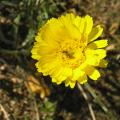
Desert marigolds are one of the prettiest desert flowers. The plant forms a neat compact rosette of finely cut silvery green leaves from which stems emerge topped with a bright golden daisy like flower. It is considered either an annual or short lived perennial. Scatter seeds from the spent plant to insure its return the next season. Over watering will doom this beautiful plant. Desert marigold can be seen blooming in the desert in winter and spring. In my garden, it's blooms begin in May and will continue sporadically into fall. Not awfully reliable in cold hardiness here.
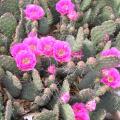
Not all succulents are cacti, nearly all cacti are succulents (a few exceptions). Nearly all cactus species are native to the Americas, providing a prickly evergreen presence. There are many cactus that are cold hardy for the Texas Panhandle. There might be one for your garden.
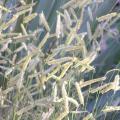
Alkali sacaton is a perennial warm season bunch grass native to the Southwest. In late summer to fall, airy triangular seed heads wave above the silver green grass blades. Grows in alkali soils, many say in locations where there is moisture nearby, prefering heavy clay soils. It is quite drought tolerant once established, and long lived. It will, of course, grow bigger or smaller depending on water resources.
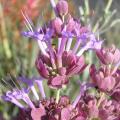
Beautiful xeric sage with aromatic soft gray green leaves, mostly evergreen. Summer to fall blooming with mauve/purple sticky but fragrant flowers. Takes a few years to reach mature height. Requires good drainage and dry soil in the winter. A Plant Select® Plant. Native to California and will grow in the High Desert regions. Cold hardy to Zone 5 and quite heat tolerant.
Drought tolerant perennial with white cup shaped blooms usually found growing in poor soils. I planted it in heavily amended soil, and I think it was too rich for it. It was eaten up during the heat of the summer by flea beetles. I thought the too rich soil was the cause; however, Judith Phillips in Plants For Natural Gardens, wrote about this same occurrence in native soils. Phillips hypothesized this may be a way for tufted evening primrose to escape summer’s heat. However, my plant died, rather than just going to ground.
Native woody shrub to Texas, New Mexico and west to California from 3000 to 8000 feet in elevation. It is best to plant in soil with only inorganic amendments. It becomes more floppy and flowers less when fed and watered well. This is a case of less yielding more.
Reseeds some. I've never seen this as a problem. Locate in a sunny area with full exposure to the sun for best growth and backlighting. If planted against a wall or fence it will lean towards the sun and looked tipped over.
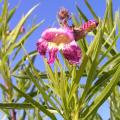
Summer flowering low water-use native tree, several varieties to choose from. Willow like green leaves. Cold hardy reliably in Zone 7, will winter over most years in Zone 6. The variety pictured in the close-up flower photo is "Lucrecia Hamilton", the variety in the third photo is 'Art's Seedless'. During early autumn snows, be quick to shake snow off the branches to avoid breakage.
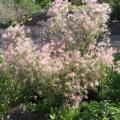
Perennial vine native to the Southwest. Late summer to fall bloom with slender, thin whitish sepals, followed by attractive plumes that are feathery seed clusters. The vine is valued for it's delicate beauty of leaf, flower and plume and drought tolerance. Clematis drummondii is a larval host and/or nectar source for the fatal metalmark butterfly.